
Archive

2025

Browsing

Shoppers are still flocking to Walmart.

The company raised its full-year earnings and sales outlook Thursday, heading into the crucial holiday shopping season.

Walmart also offered fresh signs that it is shedding its original identity as a strictly down-market brick-and-mortar operation by growing its e-commerce business and increasing its market share of higher-income shoppers.

Walmart’s shares closed more than 6% higher Thursday, even as the broader market suffered a dramatic sell-off. The stock is up more than 18% this year.

The biggest retailer and grocer in the United States acknowledged the added financial pressures on lower-income households but said middle-income families are holding up. Walmart saw more sales growth in its grocery and health and wellness product categories than in general merchandise.

‘As pocketbooks have been stretched, you’re seeing more consumer dollars go to necessities versus discretionary items,’ Chief Financial Officer John David Rainey said on a call with analysts Thursday morning.

The company reported that same-store sales for Walmart U.S. rose 4.5% in the quarter that ended Oct. 31, exceeding analysts’ expectations.

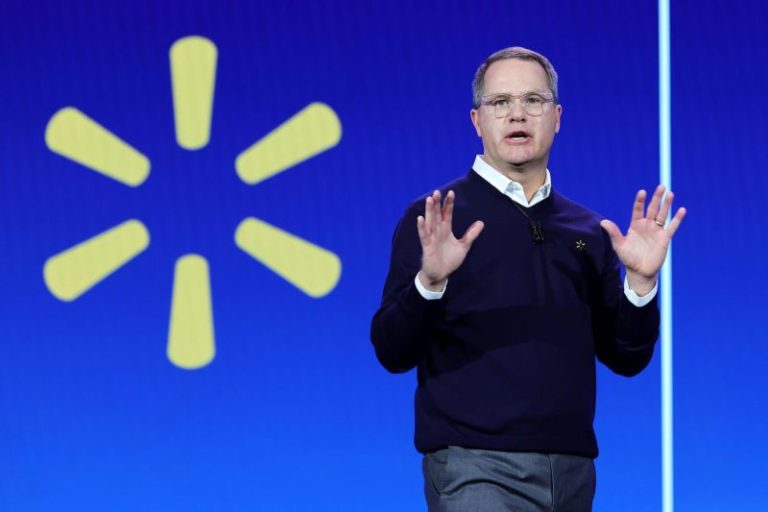
“The team delivered another strong quarter across the business. eCommerce was a bright spot again this quarter. We’re gaining market share, improving delivery speed, and managing inventory well,” outgoing CEO Doug McMillon said in a statement.

Walmart reported 27% growth in e-commerce sales globally.

Walmart also announced that it will move from trading on the New York Stock Exchange to the tech-heavy Nasdaq next month. It’s the latest sign of America’s largest private employer working to position itself as tech-forward in order to compete with Amazon.

The discounter’s third-quarter earnings come amid growing questions about whether Americans contending with tariffs, corporate layoffs and accelerating inflation are still confidently spending on retail.

As a bellwether for the U.S. economy and consumer confidence, Walmart’s strong earnings and guidance indicate that consumers are still shopping — at least at the lower end of the retail price point.

The company announced last week that McMillon will step down in January. McMillon, 59, started at Walmart as an associate in the 1980s and has helmed the company since 2014.

Under his leadership, Walmart improved pay and benefits for many employees, renovated hundreds of stores and boosted its e-commerce and delivery programs, especially during the Covid pandemic.

John Furner, CEO of Walmart U.S., will take over the top job Feb. 1. Since 2019, Furner has led Walmart’s American operations — by far the largest slice of the company, with around 1.6 million of Walmart’s approximately 2.1 million total associates worldwide.

Walmart is leading the retail race against longtime rival Target, which Wednesday reported a drop in third-quarter sales and cut its full-year profit guidance.

Target’s sales have faltered over the last few years, with some consumers expressing frustration over what they said were disorganized stores and rollbacks of the company’s diversity, equity and inclusion initiatives.

In October, Target said it would cut about 1,800 corporate jobs.

Target is hoping for a fresh start in the new year. Incoming CEO Michael Fiddelke will take over Feb. 1, the same day Furner becomes CEO of Walmart.

The struggling retailer said Wednesday that it plans to increase its investment in stores and technology next year by 25%.

Since January, U.S. businesses have had to contend with ever-changing tariffs under the Trump administration. Walmart has navigated the uncertainty by raising prices on some items, while swallowing some tariff costs on others. In the three months that ended Oct. 31, prices at Walmart U.S. rose around 1% overall, with higher prices on electronics, toys and seasonal items in particular due to tariff pressures.

In the grocery section, Walmart expects egg prices to drop but anticipates the record-breaking beef prices will stay high, in part from cattle herds shrinking over the last few decades.

Prices for other grocery staples are also up, though the Trump administration’s rollback of tariffs on many food items last week could offer some relief.

Despite the rising prices, Walmart is offering its annual Thanksgiving menu deal for 10 at less than $4 per person. It’s less expensive than last year’s package, but it also contains fewer items.

The company is also expanding its use of artificial intelligence, teaming up with OpenAI to allow customers to buy from Walmart within ChatGPT. Walmart has not detailed the terms of the partnership or shared when the new option could be available.

This week, Target announced its own collaboration with OpenAI.

Walmart has lagged behind rival Amazon in AI-driven e-commerce — Amazon debuted its Rufus shopping assistant in February 2024, more than a year before Walmart launched its counterpart, Sparky.
This post appeared first on NBC NEWS

Walmart announced Friday that longtime CEO Doug McMillon will retire at the end of January — which came as a surprise to some given the company’s success in a rapidly evolving retail landscape.

John Furner, Walmart’s U.S. CEO, will assume the role of overall CEO on Feb. 1, the company said. McMillon will continue to serve in an executive and advisory role through January 2027. Furner, 51, began his career at Walmart as an hourly associate.

McMillon, 59, has held the top job since 2014 and is only the fifth person to lead the storied company in its 63-year history.

McMillon has overseen a radical transformation of Walmart’s image in a little over a decade.

In 2014, Walmart had a reputation as a budget retail option and was accused of underpaying its associates. Today, it draws more well-to-do shoppers and has earned credit for adopting innovative personnel policies.

McMillon also built up Walmart’s e-commerce operation into the country’s second-largest, behind only Amazon. Over the course of McMillon’s tenure, the value of Walmart’s shares has increased some 300%.

“Serving as Walmart’s CEO has been a great honor and I’m thankful to our Board and the Walton family for the opportunity,” McMillon said in a statement. “I’ve worked with John for more than 20 years. … He’s uniquely capable of leading the company through this next AI-driven transformation.”

America’s retail landscape continues to rapidly evolve, as consumer spending habits increasingly bifurcate between wealthier households and everyone else.

However, Walmart’s quarterly results have held steady — and the company has been justly rewarded by investors. Just this year, Walmart shares have climbed around 13%. Over the course of McMillon’s tenure, the retailer’s stock price is up some 300%.

On Walmart’s most recent earnings call in August, McMillon indicated the company has been able to withstand the broader pressures facing consumers. Its shoppers’ “behavior has been generally consistent,” he said. “We aren’t seeing dramatic shifts.”

Other retailers have not been so fortunate.

Target’s shares have lost about one-third of their value this year, as the chain works to regain its footing in a more value-conscious environment. In August, longtime CEO Brian Cornell announced plans to step down.

Amazon, meanwhile, has fared slightly better as consumers continue to prioritize the convenience of online shopping. But it recently announced thousands of layoffs affecting corporate employees. Amazon’s share price has climbed about 8% this year.

McMillon has also steered Walmart through a volatile period in U.S. politics, during which elected officials have engaged directly with companies and consumers have proven willing to boycott corporate giants over social issues.

Walmart found itself in President Donald Trump’s crosshairs in May, after it signaled plans to increase some prices in response to his tariffs.

“Walmart should STOP trying to blame Tariffs as the reason for raising prices throughout the chain,” Trump wrote on his Truth Social platform. “Between Walmart and China they should, as is said, ‘EAT THE TARIFFS,’ and not charge valued customers ANYTHING. I’ll be watching, and so will your customers!!!”

While subsequent reports indicated that Walmart had indeed increased prices on some items, McMillon said in August that the changes were gradual enough that consumer habits shifted only modestly.

Six months after Trump singled Walmart out over tariffs, he did so again — but for a very different reason.

In recent weeks, the Trump White House has repeatedly touted Walmart’s 2025 Thanksgiving menu package — which costs less overall than the retailer’s similar menu did last year — as a sign that the president’s economic policies have helped drive down grocery prices for consumers.

But there is a flaw in that rationale. This year’s Walmart Thanksgiving menu contains fewer items than last year’s menu did.

This post appeared first on NBC NEWS

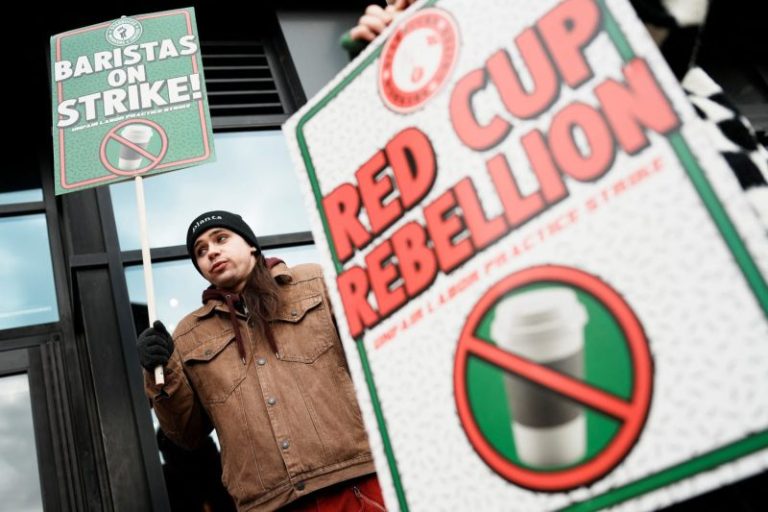
More than 1,000 unionized Starbucks workers went on strike at 65 U.S. stores Thursday to protest a lack of progress in labor negotiations with the company.

The strike was intended to disrupt Starbucks’ Red Cup Day, which is typically one of the company’s busiest days of the year. Since 2018, Starbucks has given out free, reusable cups on that day to customers who buy a holiday drink. Starbucks Workers United, the union organizing baristas, said Thursday morning that the strike had already closed some stores and was expected to force more to close later in the day.

Starbucks Workers United said stores in 45 cities would be impacted, including New York, Philadelphia, Minneapolis, San Diego, St. Louis, Dallas, Columbus, Ohio, and Starbucks’ home city of Seattle. There is no date set for the strike to end, and more stores are prepared to join if Starbucks doesn’t reach a contract agreement with the union, organizers said.

Starbucks emphasized that the vast majority of its U.S. stores would be open and operating as usual Thursday. The coffee giant has 10,000 company-owned stores in the U.S., as well as 7,000 licensed locations in places like grocery stores and airports.

As of noon Thursday on the East Coast, Starbucks said it was on track to meet or exceed its sales expectations for the day at its company-owned stores.

“The day is off to an incredible start,” the company said in a statement.

Around 550 company-owned U.S. Starbucks stores are unionized. More have voted to unionize, but Starbucks closed 59 unionized stores in September as part of a larger reorganization campaign.

Here’s what’s behind the strike.

Striking workers say they’re protesting because Starbucks has yet to reach a contract agreement with the union. Starbucks workers first voted to unionize at a store in Buffalo in 2021. In December 2023, Starbucks vowed to finalize an agreement by the end of 2024. But in August of last year, the company ousted Laxman Narasimhan, the CEO who made that promise. The union said progress has stalled under Brian Niccol, the company’s current chairman and CEO. The two sides haven’t been at the bargaining table since April.

Workers say they’re seeking better hours and improved staffing in stores, where they say long customer wait times are routine. They also want higher pay, pointing out that executives like Niccol are making millions and the company spent $81 million in June on a conference in Las Vegas for 14,000 store managers and regional leaders.

Dochi Spoltore, a barista from Pittsburgh, said in a union conference call Thursday that it’s hard for workers to be assigned more than 19 hours per week, which leaves them short of the 20 hours they would need to be eligible for Starbucks’ benefits. Spoltore said she makes $16 per hour.

“I want Starbucks to succeed. My livelihood depends on it,” Spoltore said. “We’re proud of our work, but we’re tired of being treated like we’re disposable.”

The union also wants the company to resolve hundreds of unfair labor practice charges filed by workers, who say the company has fired baristas in retaliation for unionizing and has failed to bargain over changes in policy that workers must enforce, like its decision earlier this year to limit restroom use to paying customers.

Starbucks says it offers the best wage and benefit package in retail, worth an average of $30 per hour. Among the company’s benefits are up to 18 weeks of paid family leave and 100% tuition coverage for a four-year college degree. In a letter to employees last week, Starbucks’ Chief Partner Officer Sara Kelly said the union walked away from the bargaining table in the spring.

Kelly said some of the union’s proposals would significantly alter Starbucks’ operations, such as giving workers the ability to shut down mobile ordering if a store has more than five orders in the queue.

Kelly said Starbucks remained ready to talk and “believes we can move quickly to a reasonable deal.” Kelly also said surveys showed that most employees like working for the company, and its barista turnover rates are half the industry average.

Unionized workers have gone on strike at Starbucks before. In 2022 and 2023, workers walked off the job on Red Cup Day. Last year, a five-day strike ahead of Christmas closed 59 U.S. stores. Each time, Starbucks said the disruption to its operations was minimal. Starbucks Workers United said the new strike is open-ended and could spread to many more unionized locations.

The number of non-union Starbucks locations dwarfs the number of unionized ones. But Todd Vachon, a union expert at the Rutgers School of Management and Labor Relations, said any strike could be highly visible and educate the public on baristas’ concerns.

Unlike manufacturers, Vachon said, retail industries depend on the connection between their employees and their customers. That makes shaming a potentially powerful weapon in the union’s arsenal, he said.

Starbucks’ same-store sales, or sales at locations open at least a year, rose 1% in the July-September period. It was the first time in nearly two years that the company had posted an increase. In his first year at the company, Niccol set new hospitality standards, redesigned stores to be cozier and more welcoming, and adjusted staffing levels to better handle peak hours.

Starbucks also is trying to prioritize in-store orders over mobile ones. Last week, the company’s holiday drink rollout in the U.S. was so successful that it almost immediately sold out of its glass Bearista cup. Starbucks said demand for the cup exceeded its expectations, but it wouldn’t say if the Bearista will return before the holidays are ove

This post appeared first on NBC NEWS

U.S.-based companies announced more than 153,000 job cuts in October, the research firm Challenger, Gray & Christmas reported Thursday.

“This is the highest total for October in over 20 years, and the highest total for a single month in the fourth quarter since 2008,’ the firm said in a news release.

From January through the end of October, employers have announced the elimination of nearly 1.1 million jobs. It’s the most Challenger has recorded since 2020, when the Covid-19 pandemic shut down the global economy.

“October’s pace of job cutting was much higher than average for the month,’ Andy Challenger, the firm’s chief revenue officer, said in a statement. The last time there was a higher October monthly total was in 2003.

“Some industries are correcting after the hiring boom of the pandemic, but this comes as AI adoption, softening consumer and corporate spending, and rising costs drive belt-tightening and hiring freezes,” he said.

On Wednesday, the private payroll processor ADP released its own October jobs data, showing that employers added just 42,000 jobs in the month.

The ADP report also flagged job losses in the leisure and hospitality sector as a potential sign of trouble ahead, given the industry’s acute sensitivity to consumer sentiment.

ADP’s chief economist called the losses in hospitality and leisure a ‘concerning trend.’

Both Challenger and ADP’s reports landed as major companies such as Amazon, IBM, UPS, Target, Microsoft, Paramount and General Motors announced plans to eliminate tens of thousands of jobs.

Despite the wave of downbeat economic news, the Trump administration continues to deliver an upbeat take on the current environment.

“Jobs are booming” and “inflation is falling,” Treasury Secretary Scott Bessent said Tuesday.

However, the most recent available data paints a different picture.

Inflation has also been on the rise. Prices as measured by the Consumer Price Index overall have risen every month since April.

A spokesperson for the Treasury Department did not immediately reply to a request for comment on the Challenger report.

Challenger’s report does not typically carry the same weight with economists and investors as federal jobs data, owing to its methodology.

To arrive at its figures, the firm compiles the number of job cuts companies have publicly announced. But employers may not ultimately carry out all the cuts they roll out.

Moreover, some of the job cuts that multinational companies announce could affect workers outside of the United States. Other headcount reductions could be achieved through attrition, rather than layoffs. The report also may not capture smaller layoffs over the long run.

But in the midst of a federal data blackout caused by the government shutdown, Challenger’s latest report is being read more closely than usual.

The federal government’s October jobs report that would traditionally be released Friday will not be published this week, due to the shutdown.

Other key data about the U.S. economy like GDP and an inflation indicator called PCE, closely watched by the Federal Reserve, has also been delayed.

Challenger equated the impact of AI on the current labor market to the rise of the internet in the early aughts. “Like in 2003, a disruptive technology is changing the landscape,” it said.

‘Technology continues to lead in private-sector job cuts as companies restructure amid AI integration, slower demand, and efficiency pressures,’ Challenger said.

But even firms that are not actively cutting jobs have warned that they do not plan to add to their headcount in the near term, with several pointing directly to AI’s impact on their personnel needs.

On Wednesday night, JPMorgan Chase CEO Jamie Dimon told CNN that headcount at his company would likely remain steady as the nation’s largest bank rolls out AI internally.

Goldman Sachs CEO David Solomon also recently told his employees that the firm would ‘constrain headcount growth through the end of the year,’ as it takes advantage of AI efficiencies, Bloomberg reported.

This post appeared first on NBC NEWS

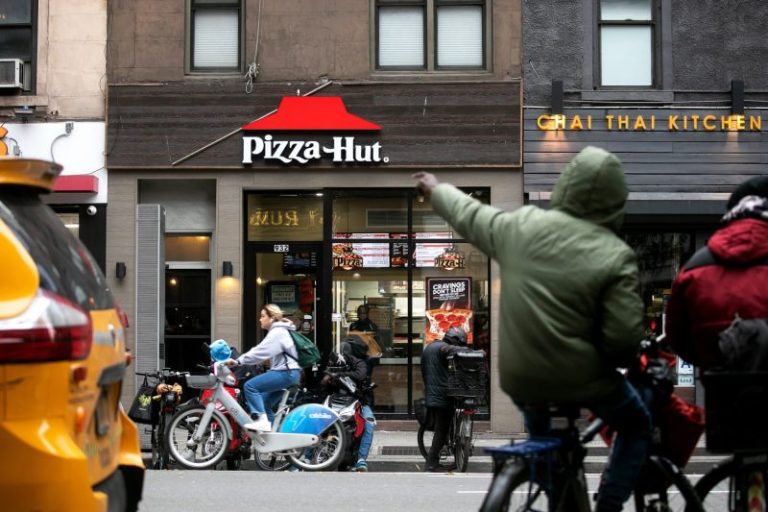
Yum Brands said on Tuesday it was exploring strategic options for its Pizza Hut chain as the unit struggles to keep pace in a highly competitive fast-food industry vying for sales from a stressed consumer.

“Pizza Hut‘s performance indicates the need to take additional action to help the brand realize its full value, which may be better executed outside of Yum Brands,” Yum Brands’ new CEO, Chris Turner, said in a statement.

Pizza Hut‘s sales have lagged Yum Brands’ other prominent units, Taco Bell and KFC International, falling for seven consecutive quarters. In comparison, Taco Bell last reported negative comparable sales in June 2020.

Yum Brands’ shares were up about 2% in premarket trading after the company banked on 7% growth in Taco Bell U.S. same-store sales and 3% growth in KFC International to beat third quarter estimates.

Pizza Hut accounts for about 11% of Yum Brands’ operating profits, compared with about 38% for Taco Bell’s U.S. business.

Several quarters of price hikes at restaurants, sticky inflation and economic uncertainty have forced consumers to become more wary about dining out as they look to stretch their budgets. Still, pizzas are viewed as a value-option to feed families.

Industry giant Domino’s Pizza DPZ.O said in October that although fast-food traffic was slowing, consumers were still seeking out its pizzas, helped by promotions and new menu items, as well as its delivery partnerships with third-party aggregators such as Doordash DASH.O and UberEats UBER.N.

While Pizza Hut has also offered value deals such as various personal pizzas for $5 and $2, “an insufficient value message amid a competitive value landscape resulted in transaction softness,” company veteran and former CEO David Gibbs said in August.

Taco Bell’s Tex-Mex cuisine and its more affordable prices have held Yum Brands in good stead against the slowdown in dining out.

Yum Brands’ worldwide same-store sales grew 3% during the quarter ended September 30, 2025 edging past estimates of a 2.68% increase, according to data compiled by LSEG.

Adjusted profit per share of $1.58 beat estimates of $1.49.

Packaged food giant PepsiCo acquired Pizza Hut in 1977, but spun off the chain along with KFC and Taco Bell in 1997 to create a restaurants company, which took on the name Yum Brands in 2002.

A deadline to complete Pizza Hut‘s strategic review has not been set, and there was no assurance that the process would result in a transaction, Yum Brands said on Friday.

This post appeared first on NBC NEWS

Kimberly-Clark said on Monday it will buy Tylenol maker Kenvue KVUE.N in a cash-and-stock deal valued at about $48.7 billion, to create one of the biggest consumer health goods companies in the United States.

Shares of Kenvue were up 18% in premarket trading, while Kimberly-Clark‘s shares were down 12.5%.

Kenvue has been under a strategic review, leadership shake-up, and mounting litigation risks. It came under fresh scrutiny following President Donald Trump’s comments linking its popular pain medicine Tylenol to autism.

The deal will bring together brands including Neutrogena, Huggies and Kleenex under a consumer health and personal care company with expected combined annual revenues of roughly $32 billion.

Sources in June told Reuters the strategic review of its operations could include a sale or breakup of the company that had been spun off from healthcare conglomerate Johnson & Johnson JNJ.N in 2023.

Kenvue‘s shareholders will receive $3.50 per share and 0.15 Kimberly-Clark shares for each Kenvue share held. That implies a per-share deal value of $21.01, or an equity value of $40.32 billion, according to Reuters calculations.

This post appeared first on NBC NEWS

President Donald Trump’s tariffs are hitting toy giants Mattel and Hasbro as the critical holiday season nears. Still, both companies see a successful year end ahead.

“This quarter, our U.S. business was again challenged by industry-wide shifts in retailer ordering patterns,” CEO Ynon Kreiz said on Mattel’s recent earnings call. “That said, consumer demand for our products grew in every region, including in the U.S.”

During the most recent quarter, which ended Sept. 30, Mattel said sales slipped 6% globally, led by a 12% decline in North America. International sales rose 3%.

Some of the company’s top performing categories included Hot Wheels and action figures, primarily from the “Jurassic World,” Minecraft and WWE franchises.

Other Mattel brands saw a drop in sales, however, including Barbie and Fisher-Price.

With retail stores waiting until the last minute to assess the level of tariffs that would apply to their holiday orders, Kreiz said “since the beginning of the fourth quarter, orders from retailers in the U.S. have accelerated significantly.”

Retailers “expect strong demand for the holiday and they are restocking,” he added.

Meanwhile, rival toy giant Hasbro’s revenue jumped 8% in the quarter and it raised its financial guidance for the rest of the year.

Key drivers of that included “Peppa Pig” and Marvel franchise toys, as well as the Wizards of the Coast games.

Hasbro “managed tariff volatility with agility” and used price hikes to protect its margins, said Gina Goetter, the company’s chief financial officer and chief operating officer.

The company remains “firmly on track” to achieve its financial targets.

“As we calculate the various scenarios of where that absolute rates will play out, we’re really putting all of our levers to work,” she said on the company’s recent earnings call.

“From how we think about pricing, how we’re thinking about our product mix, how we’re thinking about our supply chain, and how we’re managing all of our operating expenses to mitigate and offset the impact” of tariffs, she said.

For its part, Hasbro also saw “softness” in the U.S. during the quarter due to retail chains waiting longer to place holiday orders, but said momentum is accelerating as the season gets underway.

In July, Mattel’s chief financial officer, Paul Ruh, said that the company was raising prices because of tariffs.

“We have implemented a variety of actions that will help us withstand some of those headwinds and those include … supply chain efficiencies and some pricing adjustments, particularly in the U.S.,” Ruh said on the company’s earnings conference call.

“So with that array of actions, we’re able to withstand some of the uncertainty that is mostly coming in the top line,” Ruh said. “Our goal is to keep prices as low as possible for our consumers.”

Still, Kreiz said that “consumers are buying our products and the toy industry is growing.”

He also said that consumers are taking price hikes in stride and those increases haven’t hurt demand: “We are not seeing any slowdown in consumer demand so far.”

Hasbro CEO Chris Cocks said the company has also raised some prices, but it was “pretty surgical” in what it chose to adjust.

“In terms of ongoing pricing, I think we just kind of have to see how the holiday goes and the consumer holds up,” he told analysts on the company’s earnings call.

Cocks also cautioned that there may be a two-tier economy forming, something other executives and economists have observed in recent months.

“Right now, I think it’s really kind of a tale of two consumers. The top 20%, particularly in the U.S., continue to spend pretty robustly,” he said. “The balance of households are watching their wallets a bit more.”

On Friday, the Labor Department released the latest consumer price index data, which showed that inflation is rising at a 3% annual pace, up from August’s 2.9%.

In May, Kreiz told CNBC that approximately half of the company’s toys were sourced from China.

Beijing has faced some of the steepest tariffs from Washington of any U.S. trade partner, as Trump has rolled out his disruptive trade agenda this year.

Mattel’s Ruh said the company continued to adjust its supply chains in response to shifting global tariff policies.

“We will be continuing to work with our retailers to make sure that the product is on the shelf,” he said.

At the same time, Hasbro’s Goetter said the company is diversifying its supply chains away from high-tariff countries.

“By 2026, we expect approximately 30% of our total Hasbro toy and game revenue will be sourced from China and 30% of our revenue will be based in the U.S., as we opportunistically lean into our U.S. manufacturing capacity,” she said.

This post appeared first on NBC NEWS

Card-reading contact lenses, X-ray poker tables, trays of poker chips that read cards, hacked shuffling machines that predict hands. The technology alleged to have been used to execute a multistate, rigged poker operation sounds like it’s straight out of Hollywood.

And those were only some of the gadgets that authorities say were used to swindle millions of dollars from unsuspecting victims through rigged, high-dollar, underground poker games over more than five years.

A sprawling indictment unsealed Thursday by the U.S. attorney for the Eastern District of New York charged Chauncey Billups, the head coach of the NBA’s Portland Trail Blazers, and Damon Jones, a former NBA player, along with members of the Mafia and dozens of other defendants, with being part of a conspiracy.

The victims were “at the mercy of concealed technology, including rigged shuffling machines and specially designed contacts lenses and sunglasses to read the backs of playing cards, which ensured that the victims would lose big,” U.S. Attorney Joseph Nocella of Brooklyn said in a statement.

Cheating at poker is as old as poker itself. But today, wearable tech and nano-cameras are putting even upstanding poker players on their guard.

The defendants used “special contact lenses or eyeglasses that could read pre-marked cards,” Nocella said at a news conference announcing the indictments.

He also showed a photo of an X-ray table that “could read cards face down on the table … because of the X-ray technology.”

An X-ray poker table in an image from defendant Robert Stroud’s iCloud account.U.S. Justice Department

“Defendants used other cheating technologies, such as poker chip tray analyzers, which is a poker chip tray that secretly reads cards using a hidden camera,” he said.

And while marking poker cards so they are visible only with special eyewear is an old trick, new radio-frequency identification and infrared technologies have ramped up the sophistication levels.

Technically speaking, many of the devices involved in the alleged scam authorities detailed Thursday are relatively cheap to manufacture, said Sal Piacente, a gaming security consultant.

By the time they reach their customers, however, the cost of industrial shufflers or tables can easily approach $100,000, once distributors and middlemen are factored in.

“You could make a lucrative career buying this stuff,” Piacente said.

Casino and gaming security consultants told NBC News that the alleged scheme was possible only because the games were underground. In backrooms, there was none of the surveillance tech that reputable casinos use to catch players cheating.

“A lot of the features which made this scheme so successful would have been ID’d a lot sooner, or very quickly, in a traditional regulated gaming environment,” said Ian Messenger, a former U.K. law enforcement officer and founder and CEO of the Association of Certified Gaming Compliance Specialists.

More than any other tech, it was the reprogramming of the industrial card shufflers — identified in charging documents as Deckmate-brand machines — that authorities said was key to the alleged game rigging.

A DeckMate 2 shuffler taken apart on a table in an image from defendant Shane Hennen’s iCloud account. U.S. Justice Department

Deckmates are not sold directly to the public — though many used ones can be found for sale online. The ones at the high-dollar games cited in the indictment could read cards and predict which player had the best hand. Neither Deckmate nor its parent company, Light & Wonder, were implicated in any way in Thursday’s indictments.

A spokesman for Light & Wonder told NBC News in a statement that the company was aware of reports about the charges against people but said they were not affiliated with the company.

“We sell and lease our automatic card shufflers and other gaming products and services only to licensed casinos and other licensed gaming establishments,” said Andy Fouché, the company’s vice president of communications. “We will cooperate in any law enforcement investigation related to this indictment.”

Reprogramming shufflers is not a new trick. In 2023, hackers at the Black Hat security conference in Las Vegas presented research showing how to hack a Deckmate shuffler and use it to cheat.

The rigged shuffler machines would transmit information about the players’ hands to an off-site “operator,” according to prosecutors.

The computer program showing information transmitted by the rigged shuffling machine in an image from defendant Shane Hennen’s iCloud account. U.S. Justice Department

The operator would then communicate the information to someone else at the table, dubbed the “quarterback.” The victim was known as the “fish.”

Here, the high-tech gadgets met the low-tech of a card game.

The quarterback might touch the $1,000 poker chip or tap his chin or touch his black chips to indicate who at the table had the best hand.

Text messages obtained by prosecutors also appear to show defendants concerned that a fish would leave the table if he lost too many hands.

“Guys please let him win a hand he’s in for 40k in 40 minutes he will leave if he gets no traction,” read one text message released by authorities.

But according to Messenger, the consultant, it was not the tech that made the alleged scheme so successful for so long. What set it apart was the level of communication.

For example, he said, the card information had to be seamlessly passed from the dealing machines to an off-site operator and back to a person back at the table, all without alerting the fish.

“The piece that made this so successful was the coordination, not the technology,” he said.

This post appeared first on NBC NEWS

Buy Bitcoin Under $100K Before The Next Bull Run

The opportunity to buy Bitcoin under $100K may not last much longer. On April 21, 2025, Bitcoin (BTC) traded just below the $100,000 mark, a price level many analysts believe could be the last stop before a massive new rally begins. With institutional adoption rising and macroeconomic pressures easing, the case for long-term BTC growth is strengthening.

Why Now Might Be the Time to Buy Bitcoin Under $100K

Market experts point to several factors fueling the bullish sentiment. Firstly, Bitcoin’s halving event earlier this year significantly reduced block rewards, cutting daily supply by half. Historically, halving events have preceded major bull runs. Secondly, growing interest from ETFs and institutional players is creating steady buying pressure. Lastly, declining inflation and improved global liquidity conditions are encouraging investment in risk assets like Bitcoin.

According to Bitwise CIO Matt Hougan, “It’s not too late to buy Bitcoin under $100K. This could be one of the last best opportunities before we see a surge well beyond six figures.”

Long-Term Outlook for BTC Investors

Looking ahead, many analysts predict that Bitcoin could exceed $150,000 by the end of the year. While this isn’t guaranteed, trends in institutional adoption, limited supply, and rising use cases for Bitcoin suggest that prices may continue climbing.

Although short-term volatility persists, long-term investors remain focused on fundamentals. If history repeats itself, buying Bitcoin at sub-$100K levels may prove to be a decision rewarded in the coming cycle.

Final Thoughts

If you’ve been on the sidelines, now could be your moment to enter the market. The chance to buy Bitcoin under $100K might not last much longer. As always, do your research and consider your financial goals before investing.

Source: Yahoo Finance

Related: Bitcoin News | Crypto Analysis

The post Buy Bitcoin Under $100K Before The Next Bull Run appeared first on FinanceBrokerage.

Trump’s Fed Criticism Sparks Investor Concerns

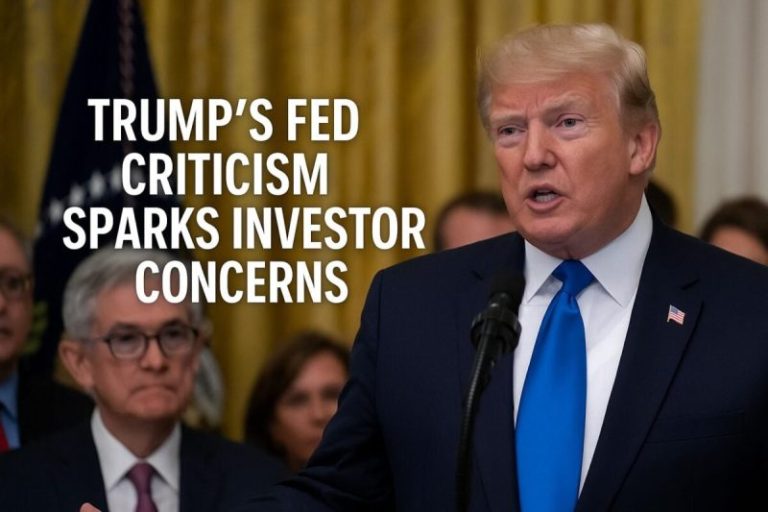
The recent spotlight on Trump’s Fed Criticism has sparked unease among investors and financial analysts alike. President Donald Trump’s repeated public attacks on Federal Reserve Chair Jerome Powell have amplified concerns over the central bank’s independence. As a result, markets have reacted with volatility, and investor sentiment has taken a noticeable hit.

Market Reactions to Political Pressure

Wall Street’s response to Trump’s Fed Criticism was swift. Major stock indices, including the S&P 500 and Nasdaq, posted losses amid uncertainty over future monetary policy decisions. Investors fear that political attempts to sway the Federal Reserve’s agenda may undermine its objectivity. If monetary policy is dictated by short-term political goals rather than long-term economic data, the implications could be severe for inflation, interest rates, and overall economic health.

Why Federal Reserve Independence Matters

One of the cornerstones of a stable economy is a politically neutral central bank. Trump’s Fed Criticism has called that neutrality into question. The Federal Reserve must be able to act without external pressure to maintain credibility in the eyes of global markets. Political interference could compromise its ability to control inflation or manage unemployment rates effectively.

Investor Sentiment and Future Outlook

Investor confidence remains fragile. Many market participants have shifted assets into safer investments such as gold and U.S. treasuries, seeking shelter from potential turmoil. Economic advisors stress the importance of maintaining clear, data-driven policy guidance, especially as the U.S. navigates ongoing trade issues and inflation concerns.

In the coming weeks, the Federal Reserve’s actions will be closely watched. Should Trump’s Fed Criticism intensify, it could further erode market stability and investor trust in U.S. monetary policy.

Source: Yahoo Finance


The post Trump’s Fed Criticism Sparks Investor Concerns appeared first on FinanceBrokerage.