
Archive

2025

Browsing

(TheNewswire)

Vancouver, British Columbia, November 5th, 2025 TheNewswire – Prismo Metals Inc. (the ‘ Company ‘ ) (CSE: PRIZ,OTC:PMOMF) (OTCQB: PMOMF) is pleased to announce that Walnut Mines LLC, the owner of the Hot Breccia claims optioned as to 75% by the Company, has agreed to extend certain dates to complete cash payments and exploration expenditures.

Alain Lambert, CEO of Prismo said: Prismo remains firmly committed to advancing the Hot Breccia Project, located in the heart of Arizona s historic copper belt. We appreciate the cooperation of Walnut Mines LLC in extending certain milestone obligations, which provides the Company with additional flexibility as we assess a range of strategic alternatives. Each of these paths is designed to position Prismo to commence drilling on what we consider one of the most compelling copper exploration opportunities in Arizona and the broader United States.

Dr Linus Keating, manager of Walnut Mines LLC, enthusiastically commented: ‘Walnut and Prismo remain firmly dedicated to advancing Hot Breccia towards drill discovery. Accomplishing that goal requires that we continue to work together and support each other. This extension will provide the necessary time, and better focus resources, to succeed at Hot Breccia.’

More specifically, the extensions are as follows: (i) extend the milestone date to complete exploration expenditures of $1,750,000 from January 31, 2026 to January 31, 2027; and (ii) extend the milestone date to complete exploration expenditures of $2,000,000 from January 31, 2027 to January 31, 2028 and (iii) extend the milestone date to complete the final cash payment of $275,000 to Walnut Mines LLC from January 31, 2026 to July 31, 2026.

Prismo s Hot Breccia project lies at the heart of the Arizona Copper Belt, which hosts several globally significant porphyry copper deposits.  Examples of these significant deposits are Freeport McMoRan’s Miami-Inspiration mining complex, BHP’s San Manuel mine, Rio Tinto and BHP’s Resolution deposit and others (see Figure 1).

Figure 1. Location of the Hot Breccia Project in the Arizona Copper Belt.

Historical drilling carried out in the mid to late 1970 s by a Rio Tinto subsidiary intersected high-grade copper mineralization at depths ranging from 640 to 830 meters below surface. Several holes targeted an area with a coincident magnetic high, believed to be caused by magnetite skarn that was cut in the drill holes and that occurs in xenoliths in cross cutting dikes exposed at the surface. Prismo believes those intercepts may represent the periphery of the upper portion of a large mineralized system.

Support for the Company s mineralization model at the project comes from several sources, including the results of historical drilling, geophysical surveys, distribution of dikes with xenoliths of Cu-bearing skarn, the 2023 ZTEM survey as well as the results of an AI study. The anomalous target area identified in Prismo s modelling measures 1,100 meters by 1,150 meters.

Dr. Craig Gibson, Chief Exploration Officer of Prismo stated: The copper exploration target at Hot Breccia has geophysical, geochemical and geological features characteristic of many porphyry copper deposits. The project area has a regional setting similar to BHP-Rio Tinto’s Resolution copper deposit located 40 kilometers to the northwest of Hot Breccia and which is considered to be one on the greatest copper discoveries in the history of North American mining. He added: The drill program is intended to drill through the entire prospective Paleozoic carbonate stratigraphy into the postulated porphyry body/breccia zone. The exploration team will take advantage of geological information provided by each hole during drilling to refine targeting of subsequent holes.

Historical drill holes cut high grade skarn mineralization including 23 meters with 0.54% Cu at 640 meters depth (hole OC-1), 18 m with 1.4% Cu and 4.65% Zn at 830 meters depth (hole OCC-7), and 7.6 m with 1.73% Cu and 0.11% Zn at 703 meters and 4.6 meters with 1.4% Cu and 0.88% Zn at 716 meters (OCC-8).  Mineralization occurs within a several hundred-meter-thick altered zone hosted in favorable Paleozoic carbonate rocks that underly a sequence of Cretaceous andesitic volcanic rocks. These carbonates are the same rocks that host the high-grade copper mineralization at Freeport s nearby Christmas mine.  The historic drilling intersected a blind mineralized intrusion associated with the skarn mineralization, providing an immediate drill target that is believed to be the source of the mineralization at Hot Breccia (Figure 2). Several magnetic highs in the region surrounding the proposed intrusion may also indicated buried skarn mineralization and provide additional exploration targets.


Click Image To View Full Size

Figure 2. Schematic cross section at Hot Breccia showing updated interpretation after Barrett (1974).

Notes:

(1) Barrett, Larry Frank (1972): Igneous Intrusions and Associated Mineralization in the Saddle Mountain Mining District Pinal County, Arizona. Unpublished Master’s Thesis, University of Utah.

(2) Barrett, Larry Frank (1974): Diamond drill hole OC-1, O’Carroll Canyon, Pinal County, Arizona, unpublished internal report, Bear Creek Mining.

About Hot Breccia

The Hot Breccia property consists of 1,420 hectares in 227 contiguous mining claims located in the world class Arizona Copper Belt between several very well understood world-class copper mines including Morenci, Ray and Resolution (Figure 1). Hot Breccia shows many features in common with these neighboring systems, most prominently a swarm of porphyry dikes and series of breccia pipes containing numerous fragments of well copper-mineralized rocks mixed with fragments of volcanic and sedimentary derived from considerable depth. Prismo performed a ZTEM survey last year that identified a very large conductive anomaly directly beneath the breccia outcrops.

Sampling at the project has shown the presence of copper mineralization associated with dacite dikes that transported fragments of strongly mineralized carbonate rocks to the surface from depths believed to be 400-1,000 meters. Drilling deep holes is necessary to tap into the source of these mineralized fragments found at surface.

Assay results from historic drill holes are unverified as the core has been destroyed, but information has been gathered from memos, photos and drill logs that contain some, but not all, of the assay results and descriptions.  Technical information from adjacent or nearby properties does not mean nor does it imply that Prismo will obtain similar results from its own properties.

Data on previous drilling and geophysics is historical in nature and has not been verified, is not compliant with NI 43-101 standards and should not be relied upon; the Company is using the information only as a guide to aid in exploration planning.

Qualified Person

Dr. Craig Gibson, PhD., CPG., a Qualified Person as defined by NI-43-01 regulations and Chief Exploration Officer and a director of the Company, has reviewed and approved the technical disclosures in this news release.

About Prismo Metals Inc.

Prismo (CSE: PRIZ,OTC:PMOMF) is a mining exploration company focused on advancing its Hot Breccia copper project in Arizona and its Palos Verdes silver project in Mexico.

Please follow @PrismoMetals on , , , Instagram , and

Prismo Metals Inc.

1100 – 1111 Melville St., Vancouver, British Columbia V6E 3V6

Contact:

Alain Lambert, Chief Executive Officer alain.lambert@prismometals.com

Gordon Aldcorn, President gordon.aldcorn@prismometals.com

Cautionary Note Regarding Forward-Looking Information

This release includes certain statements and information that may constitute forward-looking information within the meaning of applicable Canadian securities laws. Forward-looking statements relate to future events or future performance and reflect the expectations or beliefs of management of the Company regarding future events. Generally, forward-looking statements and information can be identified by the use of forward-looking terminology such as intends ‘ or anticipates , or variations of such words and phrases or statements that certain actions, events or results may’, could ‘, should ‘, would ‘ or occur . This information and these statements, referred to herein as ‘forward looking statements’, are not historical facts, are made as of the date of this news release and include without limitation, statements regarding discussions of future plans, estimates and forecasts and statements as to management’s expectations and intentions with respect to, among other things: the timing, costs and results of drilling at Hot Breccia.

These forward looking statements involve numerous risks and uncertainties, and actual results might differ materially from results suggested in any forward-looking statements. These risks and uncertainties include, among other things: delays in obtaining or failure to obtain appropriate funding to finance the exploration program at Hot Breccia.

In making the forward-looking statements in this news release, the Company has applied several material assumptions, including without limitation, that: the ability to raise capital to fund the drilling campaign at Hot Breccia and the timing of such drilling campaign.

Although management of the Company has attempted to identify important factors that could cause actual results to differ materially from those contained in forward-looking statements or forward-looking information, there may be other factors that cause results not to be as anticipated, estimated or intended. There can be no assurance that such statements will prove to be accurate, as actual results and future events could differ materially from those anticipated in such statements. Accordingly, readers should not place undue reliance on forward-looking statements and forward-looking information. Readers are cautioned that reliance on such information may not be appropriate for other purposes. The Company does not undertake to update any forward-looking statement, forward-looking information or financial out-look that are incorporated by reference herein, except in accordance with applicable securities laws. We seek safe harbor.

Copyright (c) 2025 TheNewswire – All rights reserved.

News Provided by TheNewsWire via QuoteMedia

This post appeared first on investingnews.com

Yum Brands said on Tuesday it was exploring strategic options for its Pizza Hut chain as the unit struggles to keep pace in a highly competitive fast-food industry vying for sales from a stressed consumer.

“Pizza Hut‘s performance indicates the need to take additional action to help the brand realize its full value, which may be better executed outside of Yum Brands,” Yum Brands’ new CEO, Chris Turner, said in a statement.

Pizza Hut‘s sales have lagged Yum Brands’ other prominent units, Taco Bell and KFC International, falling for seven consecutive quarters. In comparison, Taco Bell last reported negative comparable sales in June 2020.

Yum Brands’ shares were up about 2% in premarket trading after the company banked on 7% growth in Taco Bell U.S. same-store sales and 3% growth in KFC International to beat third quarter estimates.

Pizza Hut accounts for about 11% of Yum Brands’ operating profits, compared with about 38% for Taco Bell’s U.S. business.

Several quarters of price hikes at restaurants, sticky inflation and economic uncertainty have forced consumers to become more wary about dining out as they look to stretch their budgets. Still, pizzas are viewed as a value-option to feed families.

Industry giant Domino’s Pizza DPZ.O said in October that although fast-food traffic was slowing, consumers were still seeking out its pizzas, helped by promotions and new menu items, as well as its delivery partnerships with third-party aggregators such as Doordash DASH.O and UberEats UBER.N.

While Pizza Hut has also offered value deals such as various personal pizzas for $5 and $2, “an insufficient value message amid a competitive value landscape resulted in transaction softness,” company veteran and former CEO David Gibbs said in August.

Taco Bell’s Tex-Mex cuisine and its more affordable prices have held Yum Brands in good stead against the slowdown in dining out.

Yum Brands’ worldwide same-store sales grew 3% during the quarter ended September 30, 2025 edging past estimates of a 2.68% increase, according to data compiled by LSEG.

Adjusted profit per share of $1.58 beat estimates of $1.49.

Packaged food giant PepsiCo acquired Pizza Hut in 1977, but spun off the chain along with KFC and Taco Bell in 1997 to create a restaurants company, which took on the name Yum Brands in 2002.

A deadline to complete Pizza Hut‘s strategic review has not been set, and there was no assurance that the process would result in a transaction, Yum Brands said on Friday.

This post appeared first on NBC NEWS

Kimberly-Clark said on Monday it will buy Tylenol maker Kenvue KVUE.N in a cash-and-stock deal valued at about $48.7 billion, to create one of the biggest consumer health goods companies in the United States.

Shares of Kenvue were up 18% in premarket trading, while Kimberly-Clark‘s shares were down 12.5%.

Kenvue has been under a strategic review, leadership shake-up, and mounting litigation risks. It came under fresh scrutiny following President Donald Trump’s comments linking its popular pain medicine Tylenol to autism.

The deal will bring together brands including Neutrogena, Huggies and Kleenex under a consumer health and personal care company with expected combined annual revenues of roughly $32 billion.

Sources in June told Reuters the strategic review of its operations could include a sale or breakup of the company that had been spun off from healthcare conglomerate Johnson & Johnson JNJ.N in 2023.

Kenvue‘s shareholders will receive $3.50 per share and 0.15 Kimberly-Clark shares for each Kenvue share held. That implies a per-share deal value of $21.01, or an equity value of $40.32 billion, according to Reuters calculations.

This post appeared first on NBC NEWS

President Donald Trump’s tariffs are hitting toy giants Mattel and Hasbro as the critical holiday season nears. Still, both companies see a successful year end ahead.

“This quarter, our U.S. business was again challenged by industry-wide shifts in retailer ordering patterns,” CEO Ynon Kreiz said on Mattel’s recent earnings call. “That said, consumer demand for our products grew in every region, including in the U.S.”

During the most recent quarter, which ended Sept. 30, Mattel said sales slipped 6% globally, led by a 12% decline in North America. International sales rose 3%.

Some of the company’s top performing categories included Hot Wheels and action figures, primarily from the “Jurassic World,” Minecraft and WWE franchises.

Other Mattel brands saw a drop in sales, however, including Barbie and Fisher-Price.

With retail stores waiting until the last minute to assess the level of tariffs that would apply to their holiday orders, Kreiz said “since the beginning of the fourth quarter, orders from retailers in the U.S. have accelerated significantly.”

Retailers “expect strong demand for the holiday and they are restocking,” he added.

Meanwhile, rival toy giant Hasbro’s revenue jumped 8% in the quarter and it raised its financial guidance for the rest of the year.

Key drivers of that included “Peppa Pig” and Marvel franchise toys, as well as the Wizards of the Coast games.

Hasbro “managed tariff volatility with agility” and used price hikes to protect its margins, said Gina Goetter, the company’s chief financial officer and chief operating officer.

The company remains “firmly on track” to achieve its financial targets.

“As we calculate the various scenarios of where that absolute rates will play out, we’re really putting all of our levers to work,” she said on the company’s recent earnings call.

“From how we think about pricing, how we’re thinking about our product mix, how we’re thinking about our supply chain, and how we’re managing all of our operating expenses to mitigate and offset the impact” of tariffs, she said.

For its part, Hasbro also saw “softness” in the U.S. during the quarter due to retail chains waiting longer to place holiday orders, but said momentum is accelerating as the season gets underway.

In July, Mattel’s chief financial officer, Paul Ruh, said that the company was raising prices because of tariffs.

“We have implemented a variety of actions that will help us withstand some of those headwinds and those include … supply chain efficiencies and some pricing adjustments, particularly in the U.S.,” Ruh said on the company’s earnings conference call.

“So with that array of actions, we’re able to withstand some of the uncertainty that is mostly coming in the top line,” Ruh said. “Our goal is to keep prices as low as possible for our consumers.”

Still, Kreiz said that “consumers are buying our products and the toy industry is growing.”

He also said that consumers are taking price hikes in stride and those increases haven’t hurt demand: “We are not seeing any slowdown in consumer demand so far.”

Hasbro CEO Chris Cocks said the company has also raised some prices, but it was “pretty surgical” in what it chose to adjust.

“In terms of ongoing pricing, I think we just kind of have to see how the holiday goes and the consumer holds up,” he told analysts on the company’s earnings call.

Cocks also cautioned that there may be a two-tier economy forming, something other executives and economists have observed in recent months.

“Right now, I think it’s really kind of a tale of two consumers. The top 20%, particularly in the U.S., continue to spend pretty robustly,” he said. “The balance of households are watching their wallets a bit more.”

On Friday, the Labor Department released the latest consumer price index data, which showed that inflation is rising at a 3% annual pace, up from August’s 2.9%.

In May, Kreiz told CNBC that approximately half of the company’s toys were sourced from China.

Beijing has faced some of the steepest tariffs from Washington of any U.S. trade partner, as Trump has rolled out his disruptive trade agenda this year.

Mattel’s Ruh said the company continued to adjust its supply chains in response to shifting global tariff policies.

“We will be continuing to work with our retailers to make sure that the product is on the shelf,” he said.

At the same time, Hasbro’s Goetter said the company is diversifying its supply chains away from high-tariff countries.

“By 2026, we expect approximately 30% of our total Hasbro toy and game revenue will be sourced from China and 30% of our revenue will be based in the U.S., as we opportunistically lean into our U.S. manufacturing capacity,” she said.

This post appeared first on NBC NEWS

Card-reading contact lenses, X-ray poker tables, trays of poker chips that read cards, hacked shuffling machines that predict hands. The technology alleged to have been used to execute a multistate, rigged poker operation sounds like it’s straight out of Hollywood.

And those were only some of the gadgets that authorities say were used to swindle millions of dollars from unsuspecting victims through rigged, high-dollar, underground poker games over more than five years.

A sprawling indictment unsealed Thursday by the U.S. attorney for the Eastern District of New York charged Chauncey Billups, the head coach of the NBA’s Portland Trail Blazers, and Damon Jones, a former NBA player, along with members of the Mafia and dozens of other defendants, with being part of a conspiracy.

The victims were “at the mercy of concealed technology, including rigged shuffling machines and specially designed contacts lenses and sunglasses to read the backs of playing cards, which ensured that the victims would lose big,” U.S. Attorney Joseph Nocella of Brooklyn said in a statement.

Cheating at poker is as old as poker itself. But today, wearable tech and nano-cameras are putting even upstanding poker players on their guard.

The defendants used “special contact lenses or eyeglasses that could read pre-marked cards,” Nocella said at a news conference announcing the indictments.

He also showed a photo of an X-ray table that “could read cards face down on the table … because of the X-ray technology.”

An X-ray poker table in an image from defendant Robert Stroud’s iCloud account.U.S. Justice Department

“Defendants used other cheating technologies, such as poker chip tray analyzers, which is a poker chip tray that secretly reads cards using a hidden camera,” he said.

And while marking poker cards so they are visible only with special eyewear is an old trick, new radio-frequency identification and infrared technologies have ramped up the sophistication levels.

Technically speaking, many of the devices involved in the alleged scam authorities detailed Thursday are relatively cheap to manufacture, said Sal Piacente, a gaming security consultant.

By the time they reach their customers, however, the cost of industrial shufflers or tables can easily approach $100,000, once distributors and middlemen are factored in.

“You could make a lucrative career buying this stuff,” Piacente said.

Casino and gaming security consultants told NBC News that the alleged scheme was possible only because the games were underground. In backrooms, there was none of the surveillance tech that reputable casinos use to catch players cheating.

“A lot of the features which made this scheme so successful would have been ID’d a lot sooner, or very quickly, in a traditional regulated gaming environment,” said Ian Messenger, a former U.K. law enforcement officer and founder and CEO of the Association of Certified Gaming Compliance Specialists.

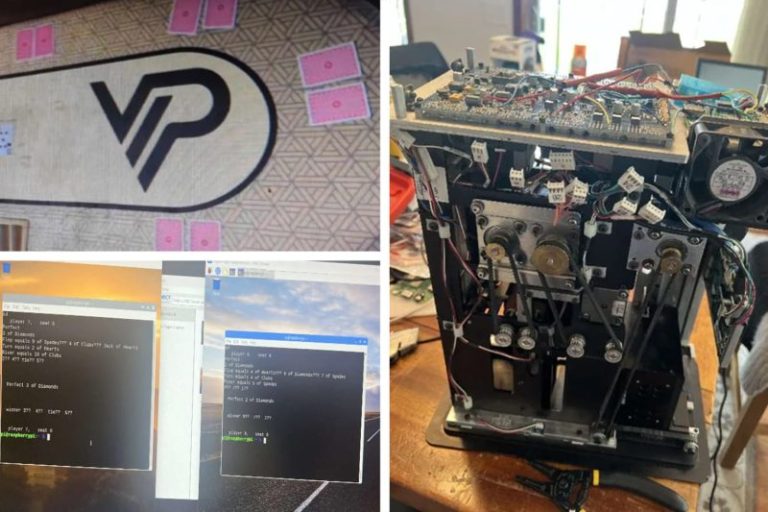
More than any other tech, it was the reprogramming of the industrial card shufflers — identified in charging documents as Deckmate-brand machines — that authorities said was key to the alleged game rigging.

A DeckMate 2 shuffler taken apart on a table in an image from defendant Shane Hennen’s iCloud account. U.S. Justice Department

Deckmates are not sold directly to the public — though many used ones can be found for sale online. The ones at the high-dollar games cited in the indictment could read cards and predict which player had the best hand. Neither Deckmate nor its parent company, Light & Wonder, were implicated in any way in Thursday’s indictments.

A spokesman for Light & Wonder told NBC News in a statement that the company was aware of reports about the charges against people but said they were not affiliated with the company.

“We sell and lease our automatic card shufflers and other gaming products and services only to licensed casinos and other licensed gaming establishments,” said Andy Fouché, the company’s vice president of communications. “We will cooperate in any law enforcement investigation related to this indictment.”

Reprogramming shufflers is not a new trick. In 2023, hackers at the Black Hat security conference in Las Vegas presented research showing how to hack a Deckmate shuffler and use it to cheat.

The rigged shuffler machines would transmit information about the players’ hands to an off-site “operator,” according to prosecutors.

The computer program showing information transmitted by the rigged shuffling machine in an image from defendant Shane Hennen’s iCloud account. U.S. Justice Department

The operator would then communicate the information to someone else at the table, dubbed the “quarterback.” The victim was known as the “fish.”

Here, the high-tech gadgets met the low-tech of a card game.

The quarterback might touch the $1,000 poker chip or tap his chin or touch his black chips to indicate who at the table had the best hand.

Text messages obtained by prosecutors also appear to show defendants concerned that a fish would leave the table if he lost too many hands.

“Guys please let him win a hand he’s in for 40k in 40 minutes he will leave if he gets no traction,” read one text message released by authorities.

But according to Messenger, the consultant, it was not the tech that made the alleged scheme so successful for so long. What set it apart was the level of communication.

For example, he said, the card information had to be seamlessly passed from the dealing machines to an off-site operator and back to a person back at the table, all without alerting the fish.

“The piece that made this so successful was the coordination, not the technology,” he said.

This post appeared first on NBC NEWS

Target said Thursday that it is eliminating about 1,800 corporate positions in an effort to streamline decision-making and accelerate initiatives to rebuild the flagging discount retailer’s customer base.

About 1,000 employees are expected to receive layoff notices next week, and the company also plans to eliminate about 800 vacant jobs, a company spokesperson said. The cuts represent about 8% of Target’s corporate workforce globally, although the majority of the affected employees work at the company’s Minneapolis headquarters, the spokesperson said.

Chief Operating Officer Michael Fiddelke, who is set to become Target’s next CEO on Feb. 1, issued a note to personnel on Thursday announcing the downsizing. He said further details would come on Tuesday, and he asked employees at the Minneapolis offices to work from home next week.

“The truth is, the complexity we’ve created over time has been holding us back,” Fiddelke, a 20-year Target veteran, wrote in his note. “Too many layers and overlapping work have slowed decisions, making it harder to bring ideas to life.”

Target, which has about 1,980 U.S. stores, lost ground to Walmart and Amazon in recent years as inflation caused shoppers to curtail their discretionary spending. Customers have complained of messy stores with merchandise that did not reflect the expensive-looking but budget-priced niche that long ago earned the retailer the jokingly posh nickname “Tarzhay.”

Fiddelke said in August when he was announced as Target’s next CEO that he would step into the role with three urgent priorities: reclaiming the company’s position as a leader in selecting and displaying merchandise; improving the customer experience by making sure shelves are consistently stocked and stores are clean; and investing in technology.

He cited the same goals in his message to employees, calling the layoffs a “necessary step in building the future of Target and enabling the progress and growth we all want to see.”

“Adjusting our structure is one part of the work ahead of us. It will also require new behaviors and sharper priorities that strengthen our retail leadership in style and design and enable faster execution,” he wrote.

Target has reported flat or declining comparable sales — those from established physical stores and online channels — in nine out of the past 11 quarters. The company reported in August that comparable sales dipped 1.9% in its second quarter, when its net income also dropped 21%.

The job cuts will not affect any store employees or workers in Target’s sorting, distribution and other supply chain facilities, the company spokesperson said.

The corporate workers losing their jobs will receive pay and benefits until Jan. 8 as well as severance packages, the spokesperson said.

This post appeared first on NBC NEWS

Buy Bitcoin Under $100K Before The Next Bull Run

The opportunity to buy Bitcoin under $100K may not last much longer. On April 21, 2025, Bitcoin (BTC) traded just below the $100,000 mark, a price level many analysts believe could be the last stop before a massive new rally begins. With institutional adoption rising and macroeconomic pressures easing, the case for long-term BTC growth is strengthening.

Why Now Might Be the Time to Buy Bitcoin Under $100K

Market experts point to several factors fueling the bullish sentiment. Firstly, Bitcoin’s halving event earlier this year significantly reduced block rewards, cutting daily supply by half. Historically, halving events have preceded major bull runs. Secondly, growing interest from ETFs and institutional players is creating steady buying pressure. Lastly, declining inflation and improved global liquidity conditions are encouraging investment in risk assets like Bitcoin.

According to Bitwise CIO Matt Hougan, “It’s not too late to buy Bitcoin under $100K. This could be one of the last best opportunities before we see a surge well beyond six figures.”

Long-Term Outlook for BTC Investors

Looking ahead, many analysts predict that Bitcoin could exceed $150,000 by the end of the year. While this isn’t guaranteed, trends in institutional adoption, limited supply, and rising use cases for Bitcoin suggest that prices may continue climbing.

Although short-term volatility persists, long-term investors remain focused on fundamentals. If history repeats itself, buying Bitcoin at sub-$100K levels may prove to be a decision rewarded in the coming cycle.

Final Thoughts

If you’ve been on the sidelines, now could be your moment to enter the market. The chance to buy Bitcoin under $100K might not last much longer. As always, do your research and consider your financial goals before investing.

Source: Yahoo Finance

Related: Bitcoin News | Crypto Analysis

The post Buy Bitcoin Under $100K Before The Next Bull Run appeared first on FinanceBrokerage.

Trump’s Fed Criticism Sparks Investor Concerns

The recent spotlight on Trump’s Fed Criticism has sparked unease among investors and financial analysts alike. President Donald Trump’s repeated public attacks on Federal Reserve Chair Jerome Powell have amplified concerns over the central bank’s independence. As a result, markets have reacted with volatility, and investor sentiment has taken a noticeable hit.

Market Reactions to Political Pressure

Wall Street’s response to Trump’s Fed Criticism was swift. Major stock indices, including the S&P 500 and Nasdaq, posted losses amid uncertainty over future monetary policy decisions. Investors fear that political attempts to sway the Federal Reserve’s agenda may undermine its objectivity. If monetary policy is dictated by short-term political goals rather than long-term economic data, the implications could be severe for inflation, interest rates, and overall economic health.

Why Federal Reserve Independence Matters

One of the cornerstones of a stable economy is a politically neutral central bank. Trump’s Fed Criticism has called that neutrality into question. The Federal Reserve must be able to act without external pressure to maintain credibility in the eyes of global markets. Political interference could compromise its ability to control inflation or manage unemployment rates effectively.

Investor Sentiment and Future Outlook

Investor confidence remains fragile. Many market participants have shifted assets into safer investments such as gold and U.S. treasuries, seeking shelter from potential turmoil. Economic advisors stress the importance of maintaining clear, data-driven policy guidance, especially as the U.S. navigates ongoing trade issues and inflation concerns.

In the coming weeks, the Federal Reserve’s actions will be closely watched. Should Trump’s Fed Criticism intensify, it could further erode market stability and investor trust in U.S. monetary policy.

Source: Yahoo Finance


The post Trump’s Fed Criticism Sparks Investor Concerns appeared first on FinanceBrokerage.

Oil Prices Rebound After Trump’s Criticism of Fed Chair Powell

On April 22, 2025, oil prices rebound experienced a modest rebound following a significant drop the previous day. The initial decline was triggered by President Donald Trump’s renewed criticism of Federal Reserve Chair Jerome Powell, which unsettled financial markets and raised concerns about the central bank’s independence.

Market Reaction to Political Commentary

President Trump’s comments on Monday intensified investor fears regarding the Federal Reserve’s autonomy in setting monetary policy. The criticism led to a broad sell-off in equities and commodities, with oil prices bearing the brunt of the market’s anxiety.

Short-Covering Leads to Price Recovery

Despite the initial plunge, oil prices rebound edged higher on Tuesday as investors engaged in short-covering. Brent crude futures rose 0.5% to $66.62 per barrel, while West Texas Intermediate (WTI) crude for May delivery increased by 1% to $63.73 per barrel. The more actively traded WTI June contract also gained 0.7% to $62.84 per barrel.

Ongoing Economic Concerns

Market participants remain cautious amid ongoing fears of a potential recession linked to U.S. tariff policies and concerns over Federal Reserve independence. These factors have increased worries about the U.S. economy and crude demand. Additionally, progress in U.S.-Iran nuclear deal talks has eased supply concerns, potentially impacting oil prices further.

As the situation evolves, investors will closely monitor geopolitical developments and central bank communications to assess the potential long-term impacts on the energy markets.

Source: BloomBurg

The post Oil Prices Rebound After Trump’s Criticism of Powell appeared first on FinanceBrokerage.

Bitcoin Nears $85K Amid Market Optimism

On April 14, 2025, Bitcoin (BTC) climbed close to the $85,000 mark, signaling a strong recovery after a period of volatility. This recent Bitcoin price surge is attributed to easing global tariff tensions and broader market stability. The rally marks a shift in sentiment, with both retail and institutional investors showing renewed confidence in the cryptocurrency market.

Key Drivers Behind Bitcoin’s Surge

Multiple economic and technical factors contributed to Bitcoin’s upward momentum:

  • Tariff Easing: The U.S. and EU signaled a pause in ongoing trade disputes, reducing uncertainty in global financial markets. As traditional investors seek alternative stores of value, Bitcoin stands out as a leading choice.
  • Stock Market Gains: Major global stock indices recorded solid growth over the past week, reflecting positive investor sentiment. Cryptocurrency trends often mirror or follow traditional markets, and BTC benefited from the spillover effect.
  • Technical Signals: Analysts noted bullish chart patterns, including a golden cross and RSI support. These indicators pushed traders to open long positions, helping fuel the rally.

Growing Investor Confidence

The return of capital to riskier assets like cryptocurrencies suggests that investors are increasingly comfortable with current market conditions. Bitcoin’s resilience during previous downturns and its growing mainstream adoption as a digital store of value are key reasons for this trust.

Several large institutions reportedly increased their BTC holdings during the dip, reaffirming long-term confidence in the asset despite short-term volatility.

What Lies Ahead for BTC?

While market optimism is high, experts advise caution. Macroeconomic variables, including inflation, interest rate decisions, and geopolitical tensions, will continue to influence price action. Investors should track these developments closely and remain diversified in their strategies.

Conclusion: Bitcoin’s approach toward $85K reflects more than just a bounce — it highlights a maturing market, increasing adoption, and greater investor awareness.

Source: CoinDesk

The post Bitcoin Nears $85K Amid Market Optimism appeared first on FinanceBrokerage.